Overview
Turbofy is an AI app builder from GraphApi.io GmbH, a German software company aiming the product at operations teams rather than professional developers. The premise is deliberately narrow: someone describes a process the team already runs, and the Turbofy assistant returns a working application with an interface, a data model, sign-in and hosting attached. Not a prototype that has to be rebuilt later, but something a team can actually keep running.
The homepage headline, "Start with a chat. Unlock your team instantly," is followed by a plain list of output types: portals, landing pages, SaaS apps, internal tools and automations. That specificity is useful, because the AI app builder category is crowded and full of vague promises. Lovable, Replit Agent, Bubble, Retool and Airtable all occupy adjacent ground, and Turbofy publishes side-by-side comparisons naming most of them.
Where Turbofy tries to draw a line is in ownership and production readiness. The pitch is not that a demo appears in seconds, but that what appears is a system the business owns and can keep changing as the business changes. Customers quoted on the site include a product studio shipping features weekly and a B2B retailer running a shop with non-programmers, which is the kind of evidence that separates a real product from a landing page.
Key Features
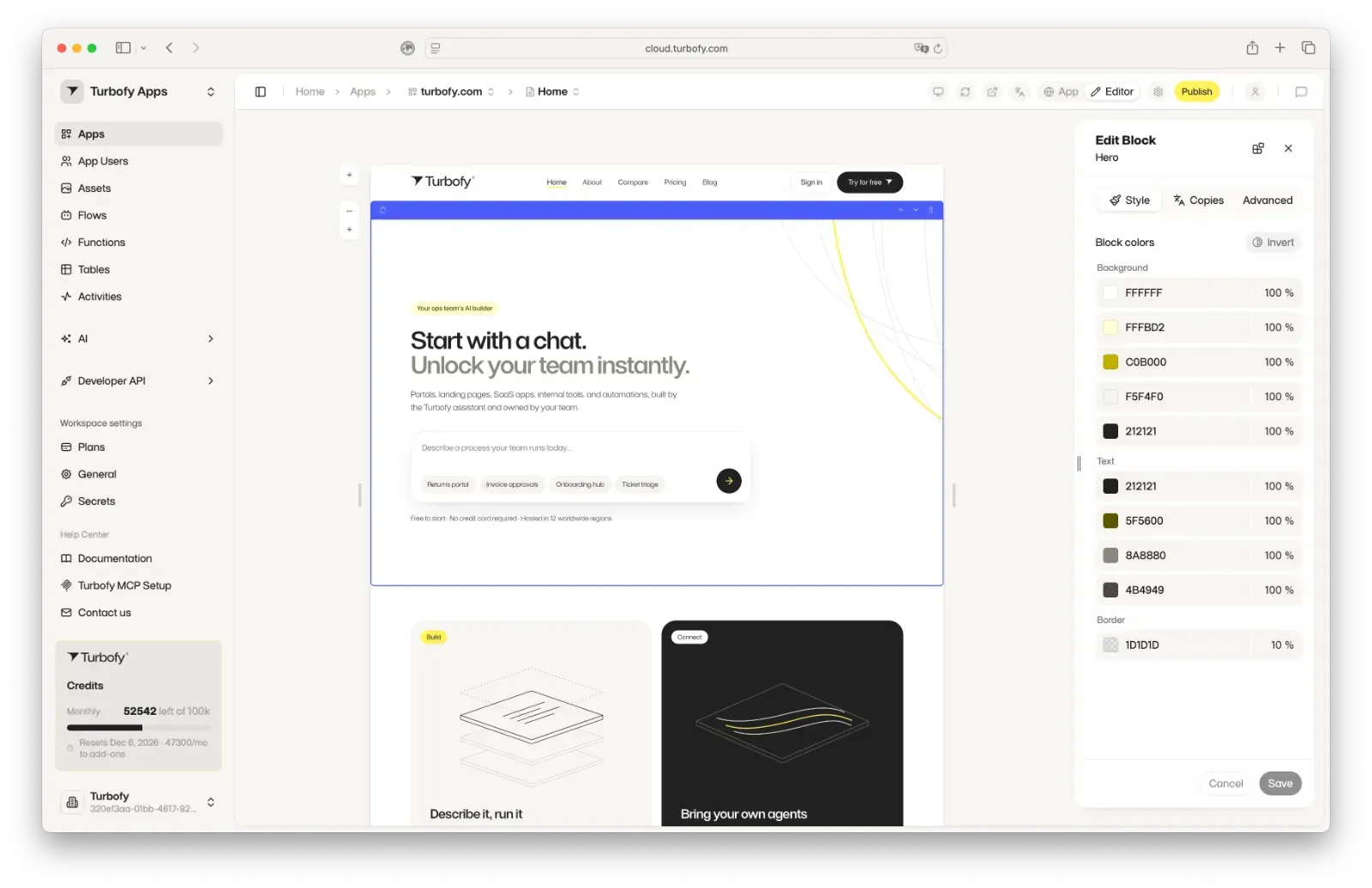
- Chat-first app creation. The main entry point is a single text field asking the user to describe a process the team runs today. From that prompt Turbofy assembles the interface, the underlying data and the automations around it. Suggested starting points on the homepage include a returns portal, invoice approvals, an onboarding hub and ticket triage, which says a lot about the intended audience.
- Bring-your-own coding agent through MCP. Rather than locking teams into one chat window, Turbofy exposes a Model Context Protocol server. Claude Code, OpenAI Codex, OpenCode and Cursor can all connect to the same workspace, so developers who already live in a terminal keep their habits while the platform still handles data and hosting. The connector is published as a plugin repository.
- Data, authentication and hosting included. Applications built on Turbofy ship with a database, user accounts and deployment as part of the package. The homepage notes hosting across twelve worldwide regions, which matters for teams with customers or staff outside Europe. There is no separate backend project to wire up afterwards.
- Automations and workflows. Beyond screens, Turbofy builds the processes that connect them. An approval route, a status change, a notification or a scheduled job can be described in the same conversation as the interface. This is the part that turns a form into a working internal tool.
- A visual editor for the last mile. Generated output is editable in the platform itself, and the product videos show designers and founders refining layout and copy with screenshots and short instructions rather than rewriting code. That combination of conversation plus direct manipulation is where most AI builders either shine or fall apart.
- Choice of models, including image generation. Turbofy is not tied to one provider. Published walkthroughs show OpenAI, Anthropic, Moonshot AI and xAI models building and refining apps, plus FLUX from Black Forest Labs and Google Gemini for image generation and editing inside an app. Model choice becomes a cost and quality dial rather than a fixed decision.
- Workspace governance and customer ownership. The comparison material positions Turbofy against tools that host apps on shared infrastructure with less control. Slack-style agent connections, sign-in management and a documented data portability page suggest a platform built for companies that need to answer security questionnaires.
How It Works
The first step is a signup at the cloud subdomain, and the homepage is explicit that no credit card is required to start. Instead of a blank dashboard, the onboarding is a prompt box, which is either refreshing or disorienting depending on the user. There are no templates to browse first, so the fastest route in is to arrive with a real process in mind rather than a vague idea.
After the initial prompt, Turbofy generates a first version of the app and opens it for review. From there the loop is conversational: describe what is wrong, add a field, change the approval step, restyle the header. Each turn commits changes to the live app. Anyone who has used a code assistant will recognise the rhythm, and anyone who has not will need a session or two to learn how much detail a prompt needs before the output improves.
For teams with developers, the second path is the MCP route. An existing coding agent is pointed at the Turbofy workspace, and from that moment the agent can read and write the same project the chat assistant builds. That means an engineer can work in an editor while an operations colleague works in the visual builder on the same application.
Deployment is continuous rather than a separate event. There is no publish button to forget, which removes one of the classic failure modes of no-code platforms, though it also means changes reach real users quickly and demand a little care.
Use Cases
An operations lead drowning in spreadsheets. Invoice approvals, ticket triage and onboarding all follow rules that live in someone's head and a shared document. Rebuilding one of those flows as a Turbofy app gives the team a proper interface with sign-in and an audit trail instead of a file everyone edits at once.
A product studio shipping on a weekly cadence. G-W Technologies, quoted on the homepage, describes Typograph shipping weekly features at a rate that previously took six months. A small team without a dedicated backend engineer gets data, auth and hosting handled together, which is where most of the delay usually hides.
A non-technical managing director running commerce. RM Components uses Turbofy for a high-performance B2B shop and the apps around it. The interesting detail is that the team describes itself as independent as non-programmers, which is the outcome most AI builder claims are really about.
A developer who prefers a terminal. An engineer who already uses Claude Code can attach the MCP server and keep working in that environment, using Turbofy purely as the backend and deployment layer. The published video walkthroughs, from an Airbnb-style marketplace clone to an agency website, show exactly this pattern.
A solo founder testing an idea. Describing a landing page or a lightweight SaaS product and getting a hosted version the same day is a cheap way to validate demand. When the idea does not survive contact with users, nothing substantial has been thrown away.
Pricing & Value
The homepage advertises a free start with no credit card, and hosting in twelve regions included from the outset, but it does not list tier prices. Anyone modelling cost needs to open the pricing page or book an intro call with the founder, which the site offers prominently for thirty minutes. The FAQ also addresses whether Turbofy adds a markup on AI tokens, a question that only makes sense if usage-based model costs flow through to customers, so budget planning should assume AI consumption is a variable line item rather than a flat fee.
Value depends on what is being compared. Against hiring a developer for an internal tool, the maths is easy. Against a general-purpose no-code platform, the argument is that data, auth and hosting are already wired, so fewer hours go into plumbing. Against a pure prompt-to-website tool, Turbofy asks more of the user up front and gives back a system rather than a page. The honest caveat is that without published tiers, teams cannot compare listings side by side before a call.
Final Verdict
Turbofy is a credible entry in a noisy category, and its strongest idea is the least flashy one: the app a chat produces should be the app the company runs. The MCP connector is the differentiator that matters most for mixed teams, because it lets engineers and non-engineers work on the same application without a translation layer. Published customer stories and a public plugin repository help, and the free start lowers the cost of finding out whether the approach fits.
There are gaps. Pricing detail sits behind a call, the workflow rewards users who can describe a process precisely, and the platform's public footprint is quieter than some competitors, with the blog and FAQ carrying most of the documentation load.
Operations teams, small product studios and founders who need working software rather than a mockup should give it a serious look, ideally by starting with one real internal process. Teams wanting a purely visual drag-and-drop builder, or a platform with published self-serve tiers and a large template gallery, will find better matches elsewhere. For everyone in between, Turbofy is worth the first conversation.