Overview
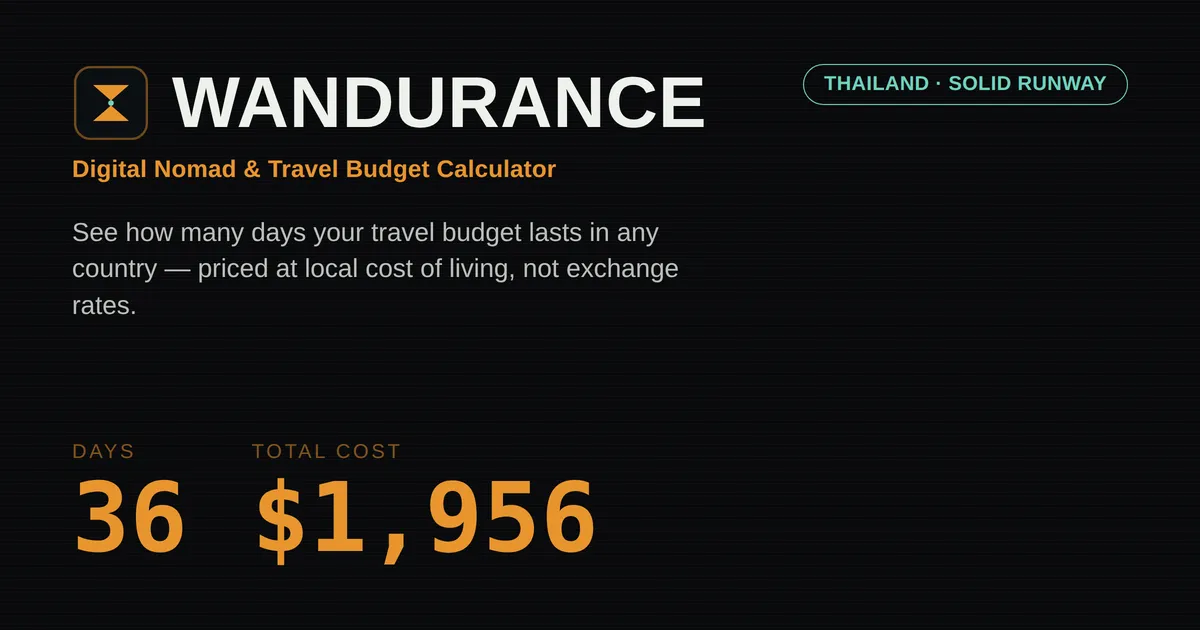
Wandurance is a free, browser-based budget calculator for digital nomads. It answers a simple question that currency converters can't: how many days will my travel budget actually last in this country? Instead of relying on exchange rates, it uses purchasing power parity (PPP), which adjusts prices to reflect what a dollar buys on the ground. That means a $50 daily budget in Thailand is compared to local costs for accommodation, food, transport, and basic medical care, not just the baht exchange rate.
The tool is built for digital nomads, backpackers, and anyone planning a long-term trip. It's a single-page app that runs entirely in the browser, with no account, no backend, and no data collection. That makes it private, fast, and available offline after the first visit. In a market crowded with cost-of-living databases and budgeting apps, Wandurance stands out by focusing on the core question of runway: how long can you afford to stay somewhere before your savings run out. It's a handy first pass for anyone weighing Chiang Mai against Lisbon or trying to stretch a gap-year budget across multiple countries.
Key Features
- PPP-based daily cost estimates
Each country gets a price-level index based on World Bank data, and Wandurance scales baseline costs for accommodation, food, local transport, and a basic medical buffer to that index. This gives a realistic daily figure for a normal traveler, rather than a number distorted by exchange rates or tourist pricing.
- Three lifestyle tiers
Frugal, Normal, and Lavish presets adjust the cost categories automatically. Frugal assumes hostels and street food, Normal uses guesthouses and sit-down meals, and Lavish covers hotels, restaurants, and taxis. Users can switch with one click to see how their spending style changes the daily number.
- City cost level adjustment
A country's index is a national average, but nomads usually base themselves in capitals or hubs that are pricier. The tool lets users toggle between "Capital / hub city" and "Smaller city / town" to shift the estimate up or down, acknowledging that one number can't represent every part of a country.
- Advanced cost overrides
Under the "Adjust daily costs" panel, travelers can manually enter their own figures for accommodation, food, transport, medical, and optional coworking. This is useful for people who already know local prices or have a unique budget. The fields reset automatically when the destination or lifestyle tier changes.
- Country comparison tool
The "Compare destinations" section lets users add multiple countries and see their daily cost, total cost, and days on a shared budget side by side. It's a fast way to evaluate different bases before committing to a flight, and it updates live as the budget changes.
- Multi-stop trip planner
For multi-country itineraries, the planner lets users stack destinations in order, assign a day count to each, and see a running total against the original budget. It highlights whether the whole route fits or needs trimming, which is ideal for backpackers and round-the-world trips.
- Share links, print, and offline support
A "Copy shareable link" button encodes the exact budget, destination, and lifestyle into a URL, so a plan can be saved or shared without an account. The app works offline after the first load, and the print view produces a clean PDF for visa applications or personal records.
How It Works
Wandurance is refreshingly simple to use. There's no signup, no onboarding, and no learning curve. The main page presents a control panel with a travel budget input, a searchable country list, and three lifestyle buttons. Users enter their total budget in US dollars, pick a destination from the autocomplete list, and choose a lifestyle tier. A two-button toggle adjusts for whether they'll be staying in a capital/hub city or a smaller town, and an optional checkbox adds a coworking and connectivity allowance.
As soon as any input changes, the results board updates instantly. A large "Days" number shows how many full days the budget covers, alongside the total cost for those days and a subtle status pill (green, amber, or red) that signals whether the budget looks comfortable or tight. Below the board, a daily cost breakdown bar and category list show exactly where the money goes: accommodation, food, local transport, medical, and coworking if enabled.
For users who want more control, the "Adjust daily costs" accordion exposes manual overrides for each category. This is handy for anyone who already knows local prices or has specific spending needs. The comparison tool sits beneath the results and allows adding up to several countries, each with its own daily cost and total, making it easy to weigh alternatives. The multi-stop planner is a separate section that lets users sequence stops and assign days, then sums everything against the budget. All interactions are client-side, so responses feel instant and the entire experience works without a network connection after the initial page load.
Use Cases
- A remote worker deciding between Lisbon and Mexico City
They enter a $12,000 budget, select Normal lifestyle and hub city toggle on both. The comparison tool shows Lisbon running out in about 4 months while Mexico City stretches to 6, giving a concrete basis for choosing a base and negotiating a lease.
- A recent grad planning a 3-month backpacking trip in Southeast Asia
They switch to Frugal, add Vietnam, Thailand, and Indonesia to the multi-stop planner, assign 20, 30, and 25 days respectively, and see the total cost against a $5,000 pot. The planner highlights whether the route is affordable or needs a shorter leg, all without opening a spreadsheet.
- An expat moving to Medellín for a year
Using the smaller city toggle (since they'll live in El Poblado, which is pricier than the national average), they adjust accommodation in the advanced panel to the $450 monthly rent they've seen, then watch the estimated daily cost update to match their real budget.
- A content creator working while traveling in Colombia and Argentina
They enable the coworking and connectivity checkbox to add a daily allowance for a desk and local SIM, then compare the two countries. The estimate now covers the real cost of uploading videos and joining client calls abroad, preventing an unpleasant surprise on the first invoice.
- A couple planning a year-long sabbatical across Europe and Asia
They use the comparison tool to test combinations like Portugal + Georgia + Vietnam, then sequence the trip in the planner. The shareable link lets them save the plan and discuss it with their travel partner, even if they're offline on a plane.
Pricing & Value
Wandurance is completely free. There are no premium plans, no subscription tiers, and no paywalled features. The entire toolkit, including the country comparison, multi-stop planner, offline mode, and shareable links, is available to everyone. This is a major plus for a travel budget tool, especially since many cost-of-living websites charge monthly fees for similar data. The lack of a backend also means there are no server costs to subsidize, so the free price feels sustainable rather than a temporary hook.
Compared to alternatives like Numbeo or Expatistan, which offer raw data but require manual calculations, Wandurance turns the same information into an instant, visual answer. Some travelers might prefer the breadth of comprehensive living databases, but for a quick pre-trip estimate, Wandurance's value is hard to beat. The only cost is a little patience with its planning-grade accuracy, which the site itself acknowledges in its methodology.
Final Verdict
Wandurance does one thing well: it tells you how many days your money will last in a foreign country using a smarter, PPP-adjusted calculation. The interface is clean, the interaction is fast, and the feature set covers everything a budget-conscious traveler needs, from side-by-side country comparisons to multi-stop itineraries. The main limitation is that the estimates are based on general cost-of-living patterns, not live listings, so actual prices can vary by season, neighborhood, and personal spending. Travelers also need to remember that flights, visas, and travel insurance aren't included, so those still require a separate budget.
For digital nomads doing pre-trip research, backpackers mapping a route, or expats checking a monthly allowance, Wandurance is a genuinely useful tool. It's free, private, and works offline, which makes it a smart addition to any traveler's toolkit. If you're about to book a flight and want an honest answer to "how long will my money last?", head over to Wandurance's website and try it. There's no reason not to, since it costs nothing and takes less than a minute to get a usable estimate.